
Tricarboxylic acids and derivatives

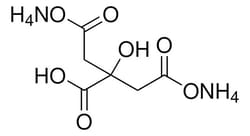
Sigma Aldrich Ammonium citrate dibasic
MilliporeSigma Sigma Organics products encompass a wide range of quality reagents, solvents, catalysts, and building blocks for organic synthesis. From benchtop discovery to process development and scale-up, Sigma Organics solutions are built to meet the needs of synthetic chemists.

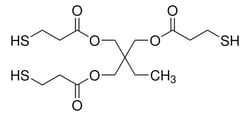
Sigma Aldrich Trimethylolpropane tris(3-mercaptopropionate)
MilliporeSigma Sigma Organics products encompass a wide range of quality reagents, solvents, catalysts, and building blocks for organic synthesis. From benchtop discovery to process development and scale-up, Sigma Organics solutions are built to meet the needs of synthetic chemists.
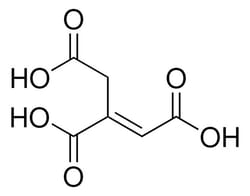
Sigma Aldrich trans-Aconitic acid
MilliporeSigma Sigma Organics products encompass a wide range of quality reagents, solvents, catalysts, and building blocks for organic synthesis. From benchtop discovery to process development and scale-up, Sigma Organics solutions are built to meet the needs of synthetic chemists.
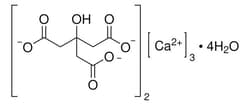
Sigma Aldrich Calcium citrate tetrahydrate
MilliporeSigma Sigma Organics products encompass a wide range of quality reagents, solvents, catalysts, and building blocks for organic synthesis. From benchtop discovery to process development and scale-up, Sigma Organics solutions are built to meet the needs of synthetic chemists.
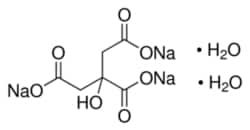
Sigma Aldrich Fine Chemicals Biosciences Trisodium citrate dihydrate | 6132-04-3 | MFCD00150031 | 500 g
Trisodium citrate dihydrate | Mol Wt: 294.10 | 6132-04-3 | MFCD00150031 | 500 g

Chem-Impex International, Inc. Tris-(carboxyethyl)phosphine hydrochloride | 51805-45-9 | MFCD00145469 | 100G
TRIS-(CARBOXYETHYL)PHOSPHINE HYDROCHLORIDE 100g


Sigma Aldrich Fine Chemicals Biosciences Sodium citrate dihydrate, 6132-04-3, MFCD00150031, 1 kg
Linear Formula: HOC(COONa)(CH2COONa)2 · 2H2O, Molecular Weight: 294.10, ≥99%, FG, Synonym: Citric acid trisodium salt dihydrate, Sodium citrate tribasic dihydrate, Trisodium citrate dihydrate. Sodium citrate dihydrate is used as a buffer, pH controlling agent, emulsifier, sequestrant and complexing agent in food industry.
Electron Microscopy Sciences Ammonium Alcohol 500 ML
Used in Alizarin Red S and Toluidine Blue O for distinction of bone and cartilage in mammalian embryos. See Dawson A.B., Stain Techn., 1:123-4, 1926, Williams, T.W., Stain Techn., 16:23-5, 1941, or Clark, G., (ed), Staining Procedures, 3rd Ed., Williams & Wilkins Baltimore, p. 139, c. 1973
Chem-Impex International, Inc. Tris-(carboxyethyl)phosphine hydrochloride | 51805-45-9 | MFCD00145469 | 1G
Tris-(carboxyethyl)phosphine hydrochloride , 51805-45-9, MFCD00145469, 1G
![Alkali Scientific 4 Methylumbelliferyl B D glucopyranoside Monohydrate [Methylumbelliferyl B D glucoside], 10 G](https://assets.fishersci.com/TFS-Assets/CCG/product-images/5000660125.jpg-250.jpg)
Alkali Scientific 4 Methylumbelliferyl B D glucopyranoside Monohydrate [Methylumbelliferyl B D glucoside], 10 G
Methylumbelliferyl β-D Glucopyranoside Monohydrate, 10 g is a biochemical reagent used for the study of glucosidase enzyme activity. This substrate is hydrolyzed by glucosidases to release a fluorescent product, making it an essential tool for enzyme assays, diagnostic tests, and research into metabolic processes. The high purity and sensitivity of this reagent make it ideal for use in microbiology, clinical diagnostics, and genetic research, where detecting small quantities of enzyme activity is crucial. It is particularly useful in enzyme kinetics studies and applications requiring accurate and high-sensitivity measurements of glucosidase activity.
Medchemexpress LLC m-PEG8-CH2COOH | 102013-72-9 | 99.9% | 100 MG

m-PEG8-CH2COOH is a PEG-based PROTAC linker that can be utilized in the synthesis of PROTACs. These compounds operate by exploiting the intracellular ubiquitin-proteasome system to selectively degrade target proteins.
- PEG-based linker
- Used in the synthesis of PROTACs
- Selectively degrades target proteins
- Molecular weight: 442.50
- Formula: C19H38O11
- Appearance: Liquid
- Color: Colorless to light yellow
- Soluble in DMSO (200 mg/mL)
Medchemexpress LLC 3,6,11-Trioxa-9-azatridecanoic acid, 12,12-dimethyl-10-oxo-. | 108466-89-3 | 263.29 | 10 G
Boc-NH-PEG2-CH2COOH is a PEG-based PROTAC linker that can be used in the synthesis of PROTACs. PROTACs are designed with two different ligands connected by this linker: one targeting an E3 ubiquitin ligase and the other for a specific protein. This mechanism exploits the intracellular ubiquitin-proteasome system to selectively degrade target proteins.
- Functions as a PEG-based PROTAC linker
- Essential for the synthesis of PROTACs
- Enables selective degradation of target proteins
- Utilizes the intracellular ubiquitin-proteasome system
Medchemexpress LLC Bromo-PEG1-CH2COOH | 1135131-50-8 | ≥97.0% | 250 MG
Bromo-PEG1-CH2COOH is a PROTAC linker instrumental in the synthesis of Proteolysis Targeting Chimeras (PROTACs). These PROTACs function by connecting two distinct ligands-one targeting an E3 ubiquitin ligase and the other a protein of interest-thereby exploiting the intracellular ubiquitin-proteasome system to achieve selective degradation of target proteins.
- Used in the synthesis of PROTACs
- Connects two different ligands
- Designed for selective degradation of target proteins
- Exploits the intracellular ubiquitin-proteasome system
- For research use only